Yes, solar panels in winter are worth it on Mallorca. A 5 kWp system still produces around 330 kWh in December and about 7,000 kWh across the year, based on a PVGIS estimate for the island. The mild winter and generous sunshine keep output high when other regions sit in the shade. Using that winter power at home cuts your bill noticeably. Learn more on our photovoltaics service page.
By Equipo técnico de Greentech Balear · Published 23 September 2026 · Updated 23 September 2026
How much power do solar panels in winter produce on Mallorca?
In short, far more than most people expect. The sun sits lower and the days are shorter, yet Mallorca remains one of the sunniest spots in Europe. According to climate data from AEMET, Palma records about 2,750 hours of sunshine a year, still roughly five hours a day in winter. That baseline makes solar panels in winter viable on the island.
The European Commission tool PVGIS estimates output by location. For Mallorca it returns roughly 1,400 to 1,500 kilowatt-hours per installed kilowatt-peak per year. A well-oriented 5 kWp system therefore reaches about 7,000 kilowatt-hours annually.
The estimate below shows how that output spreads across the year. It uses PVGIS values for an optimally oriented site on Mallorca and serves as an example:
| Period | Output of a 5 kWp system (estimate) | Share of the year |
|---|---|---|
| December (low point) | about 330 kWh | around 5 % |
| January | about 360 kWh | around 5 % |
| Winter total (Dec–Feb) | about 1,120 kWh | around 16 % |
| July (peak) | about 810 kWh | around 12 % |
| Full year | about 7,000 kWh | 100 % |
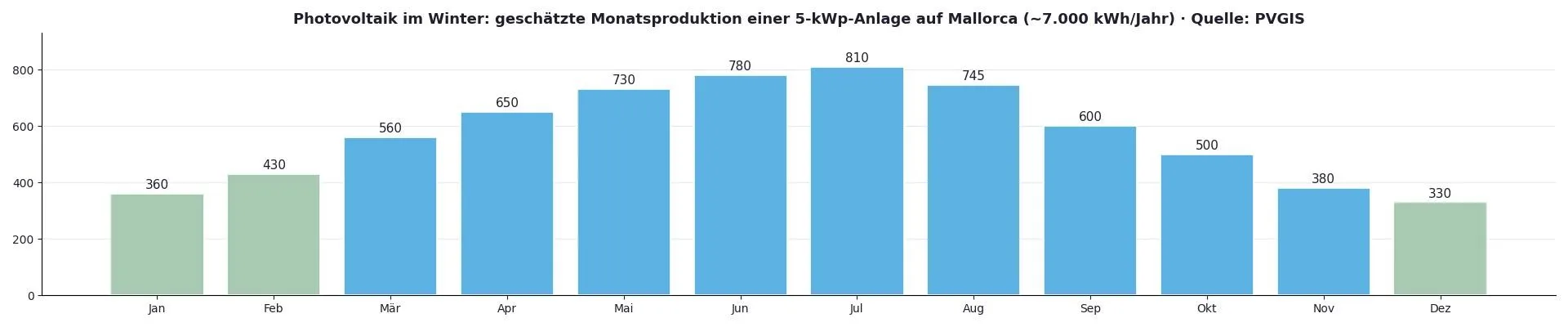
So a winter month delivers about 40 to 45 percent of a summer month. That sounds modest, yet it covers a household’s base load on many days. This is why solar panels in winter also pay off for a second home used during the colder months.
Why panels often work better in the cold
A common myth concerns temperature. Solar modules need light, not heat. Strong heat actually lowers their efficiency. According to manufacturer data, a module loses about 0.3 to 0.4 percent of its output for each degree above 25 degrees Celsius. Cool, clear winter days therefore suit the cells.
The Fraunhofer ISE, Europe’s leading solar research institute, describes this temperature effect in its reports. On a sunny January day on Mallorca, modules run near their optimum at a mild 15 degrees. The lower sun costs output, and the cool air gives part of it back.
Orientation still matters. A slightly steeper tilt helps in winter because it catches the low sun more directly. For every project we check which balance between summer and winter output fits the home’s consumption.
Self-consumption: using solar panels in winter at home
The biggest lever is self-consumption. Every kilowatt-hour you use yourself replaces expensive grid power. The regulated price (PVPC) averaged about 0.19 euros per kilowatt-hour in September 2026, a market figure used here as a basis. Consuming your solar power at home saves exactly that amount.
Winter consumption differs from summer. Instead of the air conditioner, heating, hot water and lighting draw the load. A reversible split unit, running as an air-to-air heat pump, pairs well with rooftop solar. We explain this in our posts on heating with air conditioning and solar-powered air conditioning.
This creates a useful loop. The system produces during the day, exactly when you heat and prepare hot water. The power flows straight into consumption instead of going to the grid for little money. That turns solar panels in winter from a green argument into a real saving.
Battery, grid and surplus: what happens to winter power
Not every kilowatt-hour is needed at once. A battery shifts daytime solar into the evening, when you heat and cook. In winter the battery can be smaller than in summer, because less surplus arises. Whether it pays depends on your consumption profile.
Whatever is neither used nor stored flows to the grid. In Spain, Royal Decree RD 244/2019 governs simplified surplus compensation. Exported power is credited on the bill, usually at a lower price than you pay to import. That keeps self-consumption the main lever.
Grants are worth a look too. The Balearic programme FOTOPAR supports private systems up to 5 kWp and batteries. The 2026 round closed on 30 April 2026; the regional government has announced a new window for private applicants from 26 January to 30 April 2027. Planning in winter leaves you ready for that deadline.
What a system costs and when it pays back
Cost depends on size, roof and battery. As a market guide, a turnkey system runs at about 1,000 euros per installed kilowatt-peak, so a 5 kWp system sits roughly at 5,000 to 8,000 euros before grants. The IDAE, the Spanish energy agency, documents the long-term fall in prices.
For payback, self-consumption matters most. A household saves roughly 700 to 1,200 euros a year depending on use, which works out to a payback of about six to ten years. These ranges are market figures and an example, not a fixed value for your home. Grants and high self-consumption shorten the time.
Solar panels in winter improve this maths, because the power is used directly during the heating season. If you heat and consume solar power during the day, you get more from each kilowatt-hour. The system then works for you all year.
How we plan your system for a strong winter yield
Good sizing decides the winter yield. We follow clear steps so the system fits your house and your consumption:
- On-site visit and analysis of roof, orientation and shading.
- Review of your electricity use, with an eye on winter heating demand.
- Sizing of module count, tilt and optional storage, with a PVGIS estimate.
- A quote with cost, expected output and payback, with no hidden items.
- Installation, registration and legalisation with the relevant authorities.
- Commissioning, a handover briefing and the offer of annual maintenance.
Shading is often underestimated. A tree or a neighbouring building casts longer shadows in winter, because the sun sits lower. We factor that into the design so the modules stay clear in the cold season too.

What we see across our projects on Mallorca
According to our own access data from June to September 2026, about one in three people interested in solar panels comes from German-speaking countries, namely Germany, Austria and Switzerland. Many own a second home and use it in winter too. For these owners, winter output matters, because they heat during the off-season.
A typical case, here as a worked example: a holiday home with a 6 kWp system and a reversible air conditioner covers much of its heating power from the roof on a sunny January day. Grid power drops clearly on such days. Across the winter, that adds up to real relief.
A second case concerns empty houses. A small system holds a base temperature with little power and so guards against damp. On many winter days that power comes straight from the modules. So solar panels in winter keep working even when no one is home.
Frequently asked questions about solar panels in winter on Mallorca
Do solar panels produce enough in winter?
Yes. A 5 kWp system on Mallorca delivers around 330 kilowatt-hours in December. On sunny days that covers much of the base load. Output is lower than in summer, but usable and economic.
Does the cold harm the modules?
No. Cold is not a problem for solar modules, quite the opposite. Efficiency rises slightly at low temperatures. Only snow on the modules would stop production, which almost never happens on Mallorca.
Is a battery worth it in winter?
It depends on consumption. Winter brings less surplus, so the battery is sized smaller. If you heat and use hot water in the evening, you still benefit. We check each case with your consumption data.
Can I heat with my air conditioner using solar power?
Yes. A reversible split unit heats very efficiently as an air-to-air heat pump. Running on solar power during the day, it lowers the heating bill clearly. This combination suits Mallorca especially well.
Is there any grant available right now?
The FOTOPAR programme for private applicants was open in 2026 until 30 April and is currently closed. The regional government has announced a new window from 26 January to 30 April 2027. Planning in winter prepares you for that deadline.
Sources
- AEMET — climate data and sunshine hours for the Balearic Islands: https://www.aemet.es/es/serviciosclimaticos/datosclimatologicos
- PVGIS, European Commission — solar output estimation tool: https://joint-research-centre.ec.europa.eu/photovoltaic-geographical-information-system-pvgis_en
- Fraunhofer ISE — solar research and reports: https://www.ise.fraunhofer.de/
- Energy Saving Trust — guidance on solar panels and heat pumps: https://energysavingtrust.org.uk/
- RD 244/2019 (BOE) — simplified surplus compensation for self-consumption: https://www.boe.es/eli/es/rd/2019/04/05/244/con
Your next step
Would you like to know how much your roof would produce in winter? We estimate the output for your home, plan self-consumption and storage, and work through the payback honestly. Call us on +34 644 450 672 or write to info@greentechbalear.com. Find more on our photovoltaics page and in our blog.
Equipo técnico de Greentech Balear — Our technical team designs, installs and maintains photovoltaic, air-conditioning and heating solutions across Mallorca. We write from the experience of our projects on the island.