Most owners on Mallorca know their split air conditioner only from summer. It cools the rooms when the heat builds outside, then sits idle for the rest of the year. Yet the same unit can warm your home in winter, often more cheaply than any ordinary electric heater. Heating with air conditioning is a proven, mature technology. Modern units work on the heat pump principle and deliver several times more heat than the electricity they draw. This guide explains when heating with air conditioning pays off, how efficient it is in the mild island climate, and where its limits lie. For a second home, the result is more comfort and a lower power bill.
Why heating with air conditioning makes sense on Mallorca
The first reason is simple: the unit is already on the wall. Anyone who cools in summer almost always owns a reversible system that can heat as well. Heating with air conditioning therefore avoids the cost of a second system. You need no oil tank, no new pipework, and no chimney.
The second reason is the climate. Winter on Mallorca is short and mild. In many weeks a gentle warm-up in the morning and evening is enough. That is exactly where heating with air conditioning excels, because it delivers heat at once and can be controlled room by room. You heat only where you actually are.
A third reason concerns the investment. A retrofit central-heating system with radiators and pipes is costly and disruptive. In a home that is only used part of the year, it rarely pays for itself. Heating with air conditioning uses equipment you already own and creates no building site. The effort is limited to settings and maintenance.
A fourth reason is flexibility for second homes. If you are on the island only now and then, you want to warm a house quickly, not preheat it for days. The fast response of the unit suits this pattern. The main advantages at a glance:
- No second heating system needed: the existing split unit handles both jobs.
- Warmth in minutes rather than hours, ideal for short stays.
- Room-by-room control, so you heat single rooms on demand.
- Low consumption thanks to the heat pump principle and inverter technology.
- One appliance for summer and winter, kept up in a single service contract.
There is also a benefit for the property itself. A home that can be kept comfortable all year appeals more to buyers and tenants. Heating with air conditioning turns a pure summer house into a comfortable year-round property. That can matter for off-season lettings or a later sale.
Heating with air conditioning: how the heat pump principle works
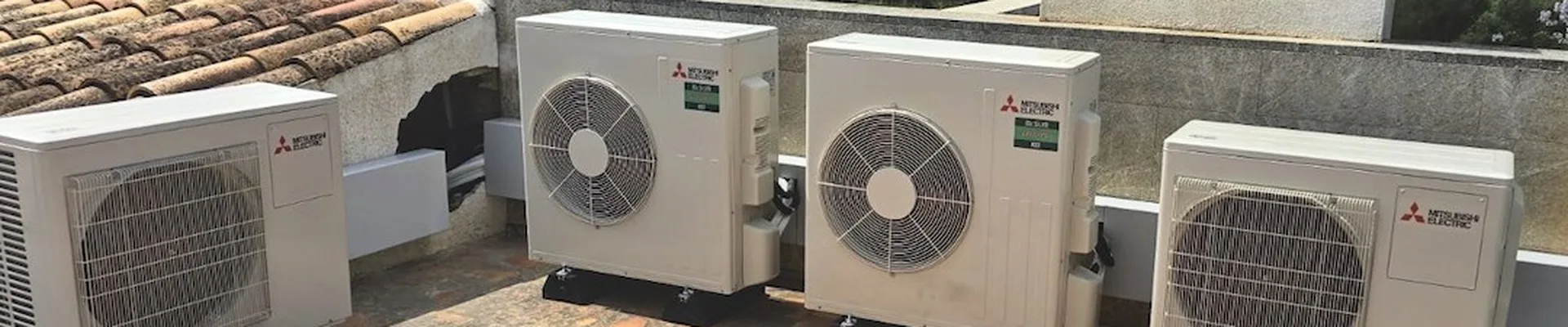
An air conditioner moves heat; it does not create it. In summer it takes heat from the room and releases it outside. In winter heating with air conditioning simply reverses that cycle. The outdoor unit draws heat from the outside air, even at low temperatures, and the indoor unit releases it into the room. Engineers call this reversible operation; at heart it is an air-to-air heat pump.
This is possible thanks to a refrigerant that evaporates at very low temperatures. A compressor lifts the temperature level so that warm air flows into the living space. Because the unit uses ambient heat that is already there, heating with air conditioning delivers more warmth than the electricity it consumes. That is the efficiency edge over a plain fan heater.
Modern units use inverter technology and R32 refrigerant. The inverter adjusts output smoothly to demand instead of switching on and off. That keeps the temperature steady and saves power. In damp cold the outdoor unit occasionally runs a short defrost cycle. In the mild island winter this happens rarely and costs little energy.
It helps to know the two main types. An air-to-air system gives its heat straight to the room air, like a split unit. An air-to-water system instead heats water for radiators or underfloor heating. Both use the same physical principle but differ in how the heat is spread. For warming single rooms quickly, the air-to-air version is usually the more practical choice.
The efficiency of heating with air conditioning: SCOP, COP and consumption

Efficiency is measured with two figures. The COP states performance at one fixed temperature. The SCOP averages performance across a whole heating season and is therefore more meaningful. Both rest on the European standard EN 14825. For heating with air conditioning, the SCOP is the number that counts.
A SCOP of 4 means one kilowatt-hour of electricity becomes four kilowatt-hours of heat. The Energy Saving Trust gives a typical SCOP of about 3.2 for air-source heat pumps. Modern split units from Daikin and Mitsubishi, the brands we work with, reach up to SCOP 5.1 in class A+++ on the datasheet. That makes heating with air conditioning one of the most economical electric heating options available.
For comparison, an electric fan heater has an efficiency of 1. It turns one kilowatt-hour of electricity into exactly one kilowatt-hour of heat. Heating with air conditioning at SCOP 4 needs only about a quarter of the power for the same warmth. The table below sets the common electric heating options side by side:
| Heating option | Heat per kWh of electricity | Assessment |
|---|---|---|
| Electric fan heater | 1.0 | Cheap to buy, costly to run |
| Night storage heater | around 1.0 | Slow, high consumption |
| Heating with air conditioning (standard) | around 3.2 (SCOP) | Very efficient, instant heat |
| Heating with air conditioning (A+++) | up to 5.1 (SCOP) | Highest efficiency in a mild climate |
The energy label helps you choose. For heating, the “warmer” climate zone is the relevant one, as it is closest to the climate of Mallorca. Check the efficiency class and the SCOP for that zone. The higher both are, the cheaper the unit heats. A note on the figures: the SCOP values come from manufacturer data under EN 14825 and from the Energy Saving Trust. The real value depends on unit, settings and climate, and in the mild south it tends to sit at the upper end.
The mild island winter as a real advantage
A heat pump works more efficiently the warmer the outside air is. This is where Mallorca plays to its strength. According to climate data from AEMET, the mean temperature in Palma in January is about 11 to 12 degrees, with daytime highs near 15 degrees. Nights close to zero are rare and brief.
These conditions are the ideal setting for heating with air conditioning. While the same technology loses efficiency in central or northern Europe during frost, the performance stays high in the island winter. The unit rarely needs to defrost and runs most of the time in its favourable range. The mild weather turns a theoretical advantage into a visibly lower electricity bill.
The building fabric plays along too. Many houses on Mallorca are built for summer and store little heat. Quick, targeted warming suits them better than a slow system that runs constantly. Warming the bathroom in the morning and the living room in the evening makes full use of the technology.
What does it cost to heat this way day to day?
Running costs depend on three things: the electricity price, the SCOP, and the heat demand of the house. The regulated electricity price (PVPC) in Spain averaged about 0.17 euros per kilowatt-hour in August 2026. That figure serves here as a basis for calculation; the actual bill varies with tariff and time of day.
A comfortable side effect concerns air quality. The filtered, moving air feels fresh, and modern filters hold back dust and pollen. Anyone who suffers from dry radiator air in winter often finds the gentle warmth more pleasant. So heating with air conditioning combines efficiency with tangible living comfort.
Our own example: an indoor unit with 3.5 kilowatts of heat output and SCOP 4 draws about 0.9 kilowatts of power. At 0.17 euros per kilowatt-hour, an hour of heating therefore costs about 15 cents. A 3.5-kilowatt fan heater would use around 60 cents in the same hour. Over a season, that difference adds up clearly.
Let us sketch a rough season. Heating for three hours morning and evening on cooler days, an efficient unit lands at roughly 40 to 50 cents per day and room. Across the few cold months the bill stays modest, as long as the unit is clean and set correctly. These amounts are our own estimate and do not replace an individual analysis.
These factors lower the cost further, in order of impact:
- A high SCOP of the unit, because it decides how much heat each kilowatt-hour produces.
- Good settings, meaning a moderate target temperature and steady running rather than constant jumps.
- The share of your own solar power from a photovoltaic system.
- A clean unit with clear filters and a serviced outdoor module.
- The use of cheaper tariff hours, if your electricity contract offers them.
Heating with air conditioning in an empty holiday home: damp protection
An often underrated benefit concerns the winter with no residents. When a house stands empty for weeks, it cools down and moisture settles on cold walls. Mould and stale air follow. Heating with air conditioning on a timer keeps the rooms at a moderate baseline and prevents exactly that.
Even a low target of about 15 to 16 degrees is enough to protect the fabric and the furniture. Some units can be controlled remotely by app, so you can preheat before you arrive. You then walk into a dry, warm house without heating all winter. For second homes, that is a strong argument.
Airing the rooms briefly at each visit helps as well. Open the windows wide for a few minutes so that damp air escapes and fresh air comes in. Combined with a moderate baseline warmth, the indoor climate stays stable all year. In the bathroom and bedroom in particular, this prevents moisture damage effectively.
Limits: when heating with air conditioning is not enough
As good as the technology is, it has limits. A split indoor unit mainly warms the air of one room. For a large, open house with many rooms, a single unit is not enough. Here you need several indoor units or a different system. Heating with air conditioning is a zonal solution, not a central heating system.
The feeling of comfort differs too. Warm air rises, and the floor stays cooler. Anyone who lives barefoot on tiles finds underfloor heating more pleasant. In such cases a heat pump with a water circuit complements heating with air conditioning well. The two technologies do not rule each other out.
The technology also shows limits in very humid rooms and in prolonged frost. Both are rare on Mallorca but worth bearing in mind. A short overview of when to consider an addition:
- A very large house with many separate rooms and high heat demand.
- A wish for warm floors instead of warm air, for example in the bathroom.
- A property lived in all year with a high, constant demand.
- A combined need for heating and hot water for the whole household.
Setting it up and maintaining it correctly

Efficiency stands or falls with how you use the unit. Set a moderate target temperature, around 20 to 21 degrees, and let the unit run steadily. Big jumps and constant on-off cycling cost more energy than smooth operation. Angle the louvres downward so the warm air reaches the floor.
Care matters just as much. Clogged filters slow the airflow and cut performance. A well-kept outdoor unit keeps efficiency high. We recommend an annual check, ideally in autumn before the heating season. More on this on our maintenance page. These simple steps keep your unit efficient:
- Clean the filters regularly, at least once per season.
- Choose a moderate target temperature and keep it constant.
- Angle the louvres downward so the room warms evenly.
- Keep doors and windows closed while heating.
- Have the outdoor unit serviced professionally once a year.
A programmable thermostat or an app refines operation further. You can tie heating times to your daily routine and warm rooms only when needed. Combining heating with air conditioning with smart control cuts consumption noticeably without any loss of comfort.
Before the first cold evening, a short test is worthwhile. Switch the unit to heating mode for a few minutes and check that warm air comes through quickly. Listen for unusual noises or smells. If the remote shows an error or the output stays weak, call a professional before winter. An early test spares you a cold surprise at the worst moment.
Combining air conditioning and photovoltaics wisely

The biggest lever for low costs is your own solar power. Even in winter, a photovoltaic system on Mallorca yields well on sunny days. If you heat during the day, you cover part of the demand straight from the roof. That lowers the grid electricity drawn, and heating with air conditioning becomes cheaper still.
The combination is especially effective in second homes with solar power unused during the day. Instead of feeding it into the grid, you turn it into room heat. How this works in detail is shown in our article on solar powered air conditioning. Details on the system technology are on our air conditioning page.
A battery extends the benefit. It stores solar power from the day and releases it in the cool evening when you heat. This raises self-consumption and makes you more independent of the grid. Whether a battery pays off depends on the system and your use, and can be clarified in a short analysis.
Frequently asked questions about heating with air conditioning
Can every air conditioner really heat? No. Only reversible units with a heat pump function can heat. Almost all modern split units can, while pure cooling units cannot. A look at the datasheet or a short call settles it.
Is heating with air conditioning worthwhile on cold nights too? Yes. In the mild island winter the efficiency mostly stays high. On the few very cold nights it drops slightly but remains well above that of a fan heater.
Does the warm air dry out the rooms? The air becomes a little drier, which even helps in damp winter months. Anyone very sensitive can place a small bowl of water in the room or air it briefly.
How loud is heating mode? Modern indoor units are very quiet. The outdoor unit is audible when running but muffled. A good installation keeps the noise low.
What does switching to heating mode cost? As a rule, nothing. A reversible unit switches to heating mode by remote control. Only with very old units can a replacement be sensible.
What about spreading heat through the whole house? One unit heats one room. For several rooms you need several indoor units or a supplementary heating system. We plan the right layout.
Heating with air conditioning or a classic heating system?
In the end it comes down to the right system. For small to medium houses with mild demand, heating with air conditioning is often the smartest and cheapest choice. For large properties with high, constant demand, a water-based heat pump makes more sense, ideally with underfloor heating. Often a mix of both solutions is the sound answer.
The overview below sorts the typical cases and helps with a first assessment:
| Situation | Recommendation | Why |
|---|---|---|
| Apartment or small house, used part-time | Heating with air conditioning | Fast, economical, no building work |
| Medium house with several zones | Several split indoor units | Room-by-room heat on demand |
| Large house lived in all year | Water-based heat pump | High, constant heat demand |
| Wish for warm floors | Heat pump with underfloor heating | Comfort underfoot |
We help you find the right option. In a short conversation we clarify your needs and show whether the existing heating with air conditioning is enough or an addition makes sense. That way you invest only in what your home truly needs.
Your next step
Would you like to use your existing unit fully in winter? We check whether your unit is reversible, measure the heat demand, and set up heating with air conditioning for best results. On request we link it to a photovoltaic system or add a heat pump. Call us on +34 644 450 672 or write to info@greentechbalear.com. You will find more articles in our blog.