Is a water softener in Mallorca worth it? It pays off when your tap water is harder than 250 mg/l as calcium carbonate and limescale affects your hot water. For Palma, the Mallorca Magazin reported about 286 mg/l in 2022, based on laboratory data from the water company Emaya. A softener swaps calcium and magnesium for sodium, so every 10 mg/l of hardness removed adds about 4.6 mg/l of sodium. To keep the water hygienic, the unit needs maintenance every six months.
By the technical team of Greentech Balear · Published 27 November 2026
How hard is tap water in Mallorca?
Tap water hardness in Mallorca depends on where your municipality gets its water. According to the Balearic government, the island is supplied by desalination plants in Palma, Alcúdia and Andratx, by the Sa Costera spring and by groundwater.
According to a Mallorca Magazin report, Palma blends water from reservoirs, desalination plants and a reverse osmosis plant to lower calcium and magnesium. For Palma, the magazine reported 16 German degrees (°dH) in 2022, or about 286 mg/l as calcium carbonate. Values in other municipalities can differ considerably.
Since 2023, Spanish water suppliers must publish hardness, calcium and magnesium online at least every six months. The Spanish health ministry's SINAC information system also shows the latest values for each supply network. The UK Drinking Water Inspectorate classifies hardness in mg/l as calcium carbonate:
- soft: up to 100 mg/l
- slightly hard: 100 to 150 mg/l
- moderately hard: 150 to 200 mg/l
- hard: 200 to 300 mg/l
- very hard: more than 300 mg/l
German sources often give hardness in °dH. One German degree equals 17.85 mg/l as calcium carbonate.
When is a water softener worth it?
A water softener is worth it above about 250 mg/l (14 °dH) to prevent limescale in your hot water system. The consumer advice centre of North Rhine-Westphalia gives this threshold. Hot water deposits more limescale than cold water, according to the German water association DVGW.
The German Environment Agency considers softeners useful where hard water is likely to disrupt appliances, for example through scale in the hot water system. The agency rejects installing one purely as a precaution. Hot water cylinders are particularly exposed, including the cylinder of a hot water heat pump.
- Choose a whole-house water softener if your water is harder than 250 mg/l and cylinders, showers or taps are scaling up.
- Choose no softener if your water is softer than 150 mg/l. Descaling individual appliances from time to time is enough.
- Choose untreated water for the garden and pool. According to the DVGW, outdoor taps generally need no softening.
How much sodium does a water softener add?
Every 10 mg/l of hardness that the water softener removes adds about 4.6 mg/l of sodium. The DVGW gives the figure as 8.2 mg/l of sodium per German degree. The softener exchanges calcium and magnesium for sodium on a resin.
Spain, like the UK and Germany, sets a limit of 200 mg/l for sodium in drinking water. The limit covers the total sodium content, including the sodium already in your tap water. You will find the current sodium value for your network in your supplier's analyses.
The DVGW advises against full softening and recommends a setting of about 150 mg/l (8.4 °dH). Calcium should not fall below 3 °dH. Spanish law requires softened water to keep at least 55 mg/l as calcium carbonate. The table shows how much sodium softening down to 150 mg/l adds.
| Starting hardness | Hardness removed | Extra sodium |
|---|---|---|
| 286 mg/l (16 °dH) | 136 mg/l | about 62 mg/l |
| 357 mg/l (20 °dH) | 207 mg/l | about 95 mg/l |
| 446 mg/l (25 °dH) | 296 mg/l | about 136 mg/l |
| 536 mg/l (30 °dH) | 386 mg/l | about 177 mg/l |
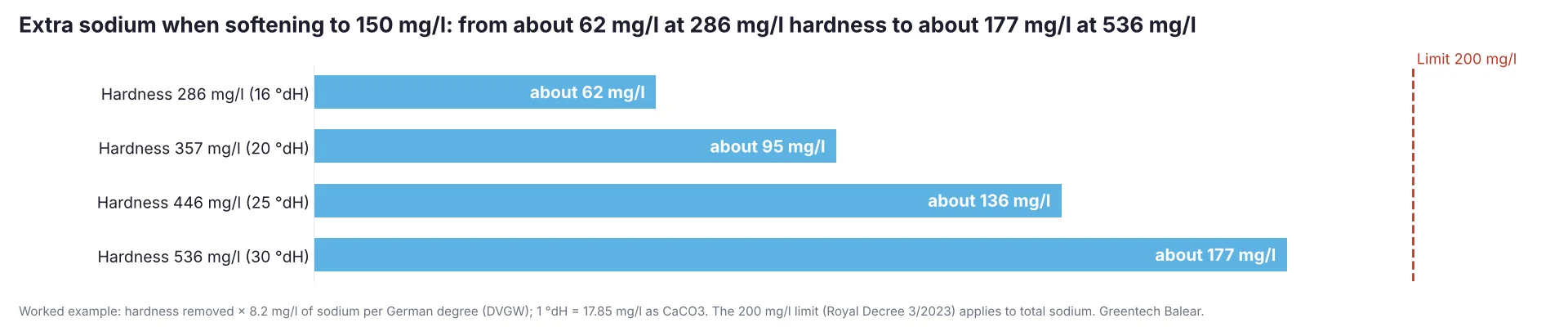
These figures are a worked example: German degrees removed multiplied by 8.2 mg/l. With a starting hardness of 536 mg/l, only 23 mg/l of sodium may already be in the tap water. If your value is higher, the installer sets a higher residual hardness.
What do Spanish rules require for water softeners?
Article 46 of Spanish Royal Decree 3/2023 regulates water treatment devices in buildings. The devices must not endanger health or spoil the colour, smell or taste of the water. Nor may they encourage microbial growth.
A unit installed after the main stopcock must meet section HS4 on water supply of the Spanish building code (CTE). Buildings with public or commercial activity face extra duties. Their operators must keep a manufacturer's declaration and tap water analyses available for the health authority. For purely private homes, Article 46 does not list these documents.
How often does a water softener need servicing?
A water softener should be inspected every two months and serviced every six months under the EN 806-5 standard. The DVGW summarises these intervals, and the manufacturer's instructions remain decisive.
An inspection checks, among other things, the salt supply and the residual hardness setting. The consumer advice centre of North Rhine-Westphalia warns that bacteria can build up when water stands still for long periods. For a holiday home left empty for months, that is a reason to book the service before you return.
Regeneration salt ends up in the environment with the waste water. Under the EN 14743 standard, a unit must remove at least 400 g of calcium carbonate per kilogram of salt. The DVGW therefore recommends softening only as much as necessary.
What else helps against limescale?
Dosing units and regular descaling also help against limescale. Dosing units add phosphates so that hardness stays dissolved for a while when the water is heated. Physical anti-scale devices aim to prevent deposits without lowering hardness, so you use the same amount of detergent. Vinegar or citric acid removes deposits on taps and tiles.
How is a water softener installed?
Installation takes four steps: testing, sizing, fitting and handover.
- Testing: The installer measures the hardness and checks the sodium value in your supplier's analysis.
- Sizing: The softener is sized to your water consumption. Pipes to the garden and pool stay untreated.
- Fitting: The softener goes after the main stopcock and the filter. It needs a built-in device that prevents backflow.
- Setting and handover: The residual hardness is set, and you receive a maintenance schedule.
Greentech Balear installs water softeners in Mallorca, and you can request a quote through the form on this website.
Frequently asked questions
Can I drink softened water?
Yes, as long as sodium stays below 200 mg/l and the minimum hardness of 55 mg/l as calcium carbonate is kept. Even so, the UK Drinking Water Inspectorate advises keeping an unsoftened supply to the kitchen tap. That tap provides water for drinking and cooking. Plan this connection when the softener is installed.
Does a water softener protect my heat pump?
A water softener reduces limescale in your hot water system, including the cylinder of a heat pump that heats your water. Hot water deposits more limescale than cold water. Above 250 mg/l, a softener therefore protects the equipment that produces your hot water. The heating circuit is a sealed loop and is filled separately.
What is the difference between a water softener and an anti-scale device?
A water softener removes calcium and magnesium and replaces them with sodium. The water becomes softer, so you need less detergent. An anti-scale device leaves the hardness unchanged and only aims to prevent deposits. According to the DVGW, detergent use does not fall with such a device. Anti-scale devices follow the manufacturer's service intervals.
How much salt does a water softener use?
Salt use depends on hardness and water consumption. A worked example: a household using 150 m³ of water a year lowers hardness from 286 to 150 mg/l. The softener removes about 20 kg of calcium carbonate in the process. Under the EN 14743 standard, that takes at most about 51 kg of salt a year.
Do I have to register a water softener?
For a purely private home, Article 46 of Royal Decree 3/2023 sets no duty to notify. Where a building has public or commercial use, the operator keeps a manufacturer's declaration and tap water analyses available. In every case, a unit after the main stopcock must meet section HS4 of the building code. Have the softener fitted by a qualified installer.
Sources
The worked examples in this article are labelled as such. All sources were accessed on 27 November 2026.
- DVGW: water treatment in domestic installations, twin March 2024 (PDF on wvr.de, in German) · wvr.de
- German Environment Agency: risks of post-treating drinking water, December 2021 (PDF on bwb.de, in German) · bwb.de
- Verbraucherzentrale NRW: water softeners and tap water (in German) · verbraucherzentrale.nrw
- BOE: Royal Decree 3/2023 on drinking water (in Spanish) · boe.es
- Balearic government: urban water supply (in Spanish) · caib.es
- Mallorca Magazin: why drinking water quality varies in Mallorca, 15 August 2022 (in German) · mallorcamagazin.com
- Drinking Water Inspectorate: domestic water filters and softeners · dwi.gov.uk
- Drinking Water Inspectorate: water hardness · dwi.gov.uk
Would you like to know whether a water softener makes sense in your home? We check beforehand. Call us on +34 644 450 672 or write to info@greentechbalear.com. You will find our servicing and support on our maintenance page.
By the technical team of Greentech Balear. We plan, install and maintain photovoltaics, heat pumps and air conditioning for property owners in Mallorca.